Underline the Sentence That Helps to Explain Why Muslium Artists Developed Calligraphy as a Fine Art
Islamic Art
Islamic art encompasses visual arts produced from the seventh century onwards past culturally Islamic populations.
Learning Objectives
Place the influences and the specific attributes of Islamic art
Key Takeaways
Key Points
- Islamic fine art is not art of a specific religion, fourth dimension, identify, or of a unmarried medium . Instead information technology spans some 1400 years, covers many lands and populations, and includes a range of artistic fields including architecture, calligraphy , painting, glass, ceramics , and textiles, among others.
- Islamic religious art differs from Christian religious fine art in that it is not-figural because many Muslims believe that the depiction of the human form is idolatry , and thereby a sin confronting God, forbidden in the Qur'an. Calligraphy and architectural elements are given important religious significance in Islamic fine art.
- Islamic art developed from many sources: Roman, early Christian art, and Byzantine styles ; Sassanian art of pre-Islamic Persia; Central Asian styles brought by diverse nomadic incursions, and Chinese influences announced on Islamic painting, pottery , and textiles.
Key Terms
- Qu'ran: The cardinal religious text of Islam, which Muslims believe to be the verbatim word of God (Arabic: Allah). It is widely regarded as the finest piece of literature in the Arabic language.
- arabesque: A repetitive, stylized design based on a geometrical floral or vegetal design.
- idolatry: The worship of idols.
- monotheistic: Believing in a single god, deity, spirit, etc., specially for an organized religion, faith, or creed.
Islam
Islam is a monotheistic and Abrahamic religion articulated by the Qur'an, a volume considered by its adherents to exist the verbatim word of God (Allah) and the teachings of Muhammad , who is considered to be the terminal prophet of God. An adherent of Islam is called a Muslim.
Most Muslims are of two denominations: Sunni (75–xc%),[seven] or Shia (10–20%). Its essential religious concepts and practices include the five pillars of Islam, which are bones concepts and obligatory acts of worship, and the post-obit of Islamic law, which touches on every aspect of life and society. The five pillars are:
- Shahadah (belief or confession of faith)
- Salat (worship in the form of prayer)
- Sawm Ramadan (fasting during the calendar month of Ramadan)
- Zakat (alms or charitable giving)
- Hajj (the pilgrimage to Mecca at least once in a lifetime)
Islamic Fine art
Islamic art encompasses the visual arts produced from the seventh century onward by both Muslims and non-Muslims who lived within the territory that was inhabited past, or ruled by, culturally Islamic populations. It is thus a very difficult art to define because it spans some 1400 years, covering many lands and populations. This art is also not of a specific religion, time, place, or unmarried medium. Instead Islamic art covers a range of artistic fields including architecture, calligraphy, painting, drinking glass, ceramics, and textiles, amidst others.
Islamic art is not restricted to religious art, but instead includes all of the fine art of the rich and varied cultures of Islamic societies. It frequently includes secular elements and elements that are forbidden by some Islamic theologians. Islamic religious art differs greatly from Christian religious art traditions.
Considering figural representations are generally considered to exist forbidden in Islam, the give-and-take takes on religious meaning in fine art every bit seen in the tradition of calligraphic inscriptions. Calligraphy and the ornament of manuscript Qu'rans is an important attribute of Islamic fine art as the word takes on religious and artistic significance.
Islamic architecture, such every bit mosques and deluxe gardens of paradise, are too embedded with religious significance. While examples of Islamic figurative painting do exist, and may cover religious scenes, these examples are typically from secular contexts, such every bit the walls of palaces or illuminated books of poetry.
Other religious fine art, such as glass mosque lamps, Girih tiles, woodwork, and carpets usually demonstrate the aforementioned style and motifs as gimmicky secular art, although they showroom more prominent religious inscriptions.
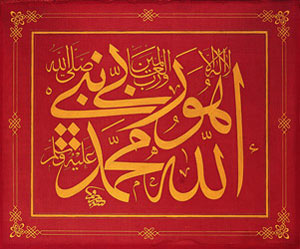
A calligraphic console past Mustafa Râkim (tardily 18th–early 19th century): Islamic art has focused on the delineation of patterns and Arabic calligraphy, rather than on figures, considering it is feared by many Muslims that the delineation of the human being form is idolatry. The panel reads: "God, at that place is no god only He, the Lord of His prophet Muhammad (peace exist upon him) and the Lord of all that has been created."
Islamic art was influenced by Greek, Roman, early Christian, and Byzantine fine art styles, likewise as the Sassanian art of pre-Islamic Persia. Central Asian styles were brought in with various nomadic incursions; and Chinese influences had a formative effect on Islamic painting, pottery, and textiles.
Themes of Islamic Art
There are repeating elements in Islamic art, such as the use of stylized , geometrical floral or vegetal designs in a repetition known as the arabesque . The arabesque in Islamic art is often used to symbolize the transcendent, indivisible and space nature of God. Some scholars believe that mistakes in repetitions may be intentionally introduced as a show of humility by artists who believe only God can produce perfection.

Arabesque inlays at the Mughal Agra Fort, Republic of india: Geometrical designs in repetition, know as Arabesque, are used in Islamic art to symbolize the transcendent, indivisible, and infinite nature of God.
Typically, though not entirely, Islamic fine art has focused on the delineation of patterns and Arabic calligraphy, rather than man or animal figures, because information technology is believed by many Muslims that the depiction of the homo form is idolatry and thereby a sin against God that is forbidden in the Qur'an.
However, depictions of the human form and animals can exist constitute in all eras of Islamic secular art. Depictions of the human form in fine art intended for the purpose of worship is considered idolatry and is forbidden in Islamic law, known as Sharia law.
Islamic Architecture
Islamic architecture encompasses a broad range of styles and the chief example is the mosque.
Learning Objectives
Describe the development of mosques, and their different features during different periods and dynasties
Key Takeaways
Key Points
- A specifically recognizable Islamic architectural style emerged soon after Muhammad'south time that incorporated Roman edifice traditions with the add-on of localized adaptations of the former Sassanid and Byzantine models.
- The Islamic mosque has historically been both a place of prayer and a community meeting space . The early mosques are believed to exist inspired past Muhammad'southward home in Medina, which was the first mosque.
Key Terms
- mosque: A identify of worship for Muslims, corresponding to a church or synagogue in other religions, often having at least i minaret. In Standard arabic: masjid.
- mihrab: A semicircular niche in the wall of a mosque, that indicates the qibla (direction of Mecca), and into which the imam prays.
- minaret: The tall slender tower of an Islamic mosque, from which the muezzin recites the adhan (call to prayer).
Islamic Architecture
Islamic architecture encompasses a wide range of both secular and religious styles. The chief Islamic architectural example is the mosque. A specifically recognizable Islamic architectural manner emerged shortly after Muhammad'south time that incorporated Roman building traditions with the improver of localized adaptations of the former Sassanid and Byzantine models.
Early Mosques
The Islamic mosque has historically been both a place of prayer and a community meeting space. The early mosques are believed to be inspired by Muhammad'southward dwelling house in Medina, which was the first mosque.
The Keen Mosque of Kairouan (in Tunisia) is one of the best preserved and most significant examples of early on peachy mosques. Founded in 670, it contains all of the architectural features that distinguish early on mosques: a minaret , a large courtyard surrounded past porticos , and a hypostyle prayer hall.

Dome of the mihrab (9th century) in the Peachy Mosque of Kairouan, also known as the Mosque of Uqba, in Kairouan, Tunisia: This is considered to exist the ancestor of all the mosques in the western Islamic world.
Ottoman Mosques
Ottoman mosques and other compages beginning emerged in the cities of Bursa and Edirne in the 14th and 15th centuries, developing from earlier Seljuk Turk architecture, with additional influences from Byzantine, Western farsi, and Islamic Mamluk traditions.
Sultan Mehmed II would later fuse European traditions in his rebuilding programs at Istanbul in the 19th century. Byzantine styles equally seen in the Hagia Sophia served as especially important models for Ottoman mosques, such as the mosque constructed by Sinan.
Building reached its peak in the 16th century when Ottoman architects mastered the technique of edifice vast inner spaces surmounted by seemingly weightless yet incredibly massive domes , and accomplished perfect harmony between inner and outer spaces, as well equally articulated light and shadow.
They incorporated vaults , domes, foursquare dome plans, slender corner minarets, and columns into their mosques, which became sanctuaries of transcendently aesthetic and technical residual, as may be observed in the Blue Mosque in Istanbul, Turkey.

The Blue Mosque, Istanbul, Turkey: The Blueish Mosque represents the culmination of Ottoman structure with its numerous domes, slender minarets and overall harmony.
Architecture flourished in the Safavid Dynasty , attaining a high point with the building programme of Shah Abbas in Isfahan, which included numerous gardens, palaces (such equally Ali Qapu), an immense bazaar, and a large purple mosque. Isfahan, the capital of both the Seljuk and Safavid dynasties, bears the virtually prominent samples of the Safavid architecture, such as the the Imperial Mosque, which was constructed in the years after Shah Abbas I permanently moved the capital there in 1598.

Imperial Mosque, Isfahan, Iran: Isfahan, the capital letter of both the Seljuk and Safavid dynasties, bears the most prominent samples of the Safavid architecture.
Islamic Glass Making
Glassmaking was the almost important Islamic luxury art of the early Middle Ages.
Learning Objectives
Describe the art of Islamic glass
Key Takeaways
Key Points
- Betwixt the 8th and early on 11th centuries, the emphasis in luxury glass was on effects achieved by manipulating the surface of the glass, initially by incising into the glass on a bike, and afterwards past cut away the background to leave a design in relief .
- Lustre painting uses techniques similar to lustreware in pottery and dates back to the 8th century in Egypt; it became widespread in the 12th century.
Key Terms
- luxury arts: Highly decorative appurtenances made of precious materials for the wealthy classes.
- glassmaking: The craft or industry of producing drinking glass.
Islamic Glass
For near of the Middle Ages , Islamic luxury drinking glass was the about sophisticated in Eurasia , exported to both Europe and Cathay. Islam took over much of the traditional glass-producing territory of Sassanian and Ancient Roman drinking glass. Since figurative decoration played a small part in pre-Islamic glass, the change in style was not abrupt—except that the whole area initially formed a political whole, and, for example, Persian innovations were at present almost immediately taken upward in Arab republic of egypt.
For this reason it is often impossible to distinguish between the diverse centers of production (of which Arab republic of egypt, Syria, and Persia were the most important), except past scientific assay of the cloth, which itself has difficulties. From diverse documentary references, glassmaking and glass-trading seems to have been a specialty of the Jewish minority.
Between the 8th and early 11th centuries, the emphasis in luxury drinking glass was on effects achieved by manipulating the surface of the drinking glass, initially by incising into the glass on a bike, and later on past cut away the background to exit a design in relief. The very massive Hedwig glasses, only establish in Europe, but unremarkably considered Islamic (or possibly from Muslim craftsmen in Norman Sicily), are an instance of this, though they are puzzlingly late in engagement.
These and other glass pieces probably represented cheaper versions of vessels of carved rock crystal (clear quartz)—themselves influenced past before glass vessels—and at that place is some evidence that at this period drinking glass and hard-stone cutting were regarded every bit the same arts and crafts. From the 12th century, the drinking glass industry in Persia and Mesopotamia declined, and the principal production of luxury glass shifted to Arab republic of egypt and Syria. Throughout this period, local centers made simpler wares, such as Hebron glass in Palestine.

The Luck of Edenhall: This is a 13th-century Syrian beaker, in England since the Middle Ages. For most of the Middle Ages, Islamic glass was the almost sophisticated in Eurasia, exported to both Europe and China.
Lustre painting
Lustre painting, past techniques like to lustreware in pottery, dates back to the 8th century in Egypt, and involves the application of metallic pigments during the glass-making process. Another technique used past artisans was decoration with threads of glass of a different colour, worked into the principal surface, and sometimes manipulated by combing and other effects.
Gilded, painted, and enameled glass were added to the repertoire, equally were shapes and motifs borrowed from other media , such as pottery and metalwork . Some of the finest work was in mosque lamps donated by a ruler or wealthy man.
As decoration grew more elaborate, the quality of the basic glass decreased, and information technology ofttimes exhibited bubbling and a chocolate-brown-yellow tinge. Aleppo ceased to be a major center after the Mongol invasion of 1260, and Timur appears to have ended the Syrian glass industry around 1400 by carrying off the skilled workers to Samarkand. By about 1500, the Venetians were receiving big orders for mosque lamps.
Some of the finest work was in mosque lamps donated by a ruler or wealthy man. Every bit decoration grew more elaborate, the quality of the basic drinking glass decreased, and information technology oftentimes exhibited bubbles and a brownish-yellowish tinge. Aleppo ceased to exist a major centre after the Mongol invasion of 1260, and Timur appears to have ended the Syrian industry effectually 1400 by conveying off the skilled workers to Samarkand. Past about 1500, the Venetians were receiving big orders for mosque lamps.

Mosque lamp: Produced in Arab republic of egypt, c. 1360.
Islamic Calligraphy
Calligraphic design was omnipresent in Islamic fine art in the Middle Ages, and is seen in all types of art including architecture and the decorative arts.
Learning Objectives
Explain the purpose and characteristics of Islamic calligraphy
Key Takeaways
Key Points
- In a religion where figural representations are considered an act of idolatry , information technology is no surprise that the discussion and its artistic representation became an of import aspect in Islamic art.
- The earliest course of Arabic calligraphy is Kufic script .
- Too Quranic verses, other inscriptions include verses of poetry, and inscriptions recording buying or donation.
Central Terms
- Kufic script: The earliest grade of Arabic calligraphy, noted for its angular class.
- calligraphy: The art of writing letters and words with decorative strokes.
In a faith where figural representations are considered an act of idolatry, it is no surprise that the discussion and its artistic representation became an of import attribute in Islamic art. The most important religious text in Islam is the Quran, which is believed to be the word of God. There are many examples of calligraphy and calligraphic inscriptions pertaining to verses from the Quran in Islamic arts.

9th century Quran: This early Quran demonstrates the Kufic script, noted for its angular form and as the earliest form of Arabic calligraphy .
The earliest course of Arabic calligraphy is Kufic script, which is noted for its angular grade. Standard arabic is read from right to left and only the consonants are written. The black ink in the image above from a 9th century Quran marks the consonants for the reader. The red dots that are visible on the folio note the vowels.
However, calligraphic pattern is not express to the book in Islamic art. Calligraphy is plant in several different types of fine art, such as architecture. The interior of the Dome of the Rock (Jerusalem, circa 691), for example, features calligraphic inscriptions of verses from the Quran as well as from additional sources. Every bit in Europe in the Middle Ages , religious exhortations such every bit Quranic verses may exist included in secular objects, specially coins, tiles, and metalwork .

Interior view of the Dome of the Stone: The interior of The Dome of the Rock features many calligraphic inscriptions, from both the Quran and other sources; it demonstrates the importance of calligraphy in Islamic art and its use in several different media.
Calligraphic inscriptions were not sectional to the Quran, but also included verses of poetry or recorded ownership or donation. Calligraphers were highly regarded in Islam, which reinforces the importance of the give-and-take and its religious and artistic significance.
Islamic Volume Painting
Manuscript painting in the late medieval Islamic world reached its height in Persia, Syria, Republic of iraq, and the Ottoman Empire.
Learning Objectives
Discuss the origin and development of Islamic manuscript painting
Key Takeaways
Primal Points
- The fine art of the Western farsi book was born under the Ilkhanid dynasty and encouraged past the patronage of aristocrats for large illuminated manuscripts .
- Islamic manuscript painting witnessed its first golden historic period in the 13th century when information technology was influenced by the Byzantine visual vocabulary and combined with Mongol facial types from 12th-century volume frontispieces.
- Nether the rule of the Safavids in Iran (1501 to 1786), the art of manuscript illumination achieves new heights, in particular in the Shahnameh of Shah Tahmasp, an immense re-create of Ferdowsi's ballsy poem that contains more than 250 paintings.
- The medieval Islamic texts called Maqamat were some of the earliest coffee-table books and among the first Islamic art to mirror daily life.
- Masterpieces of Ottoman manuscript illustration include the two books of festivals, i from the end of the 16th century and the other from the era of Sultan Murad III.
Cardinal Terms
- Mongols: An umbrella term for a big group of Mongolic and Turkic tribes united nether the rule of Genghis Khan in the 13th century.
- illuminated manuscripts: A book in which the text is supplemented by the addition of decoration, such as decorated initials, borders (marginalia), and miniature illustrations.
- miniature: An illustration in an aboriginal or medieval illuminated manuscript.
- muraqqa: An album in book course containing Islamic miniature paintings and specimens of Islamic calligraphy, normally from several different sources, and perhaps other matter.
- Maqamat: The plural for Maqāma, an Arabic literary genre of rhymed prose with intervals of poetry that oftentimes ruminates on spiritual topics.
Islamic Book Painting
Volume painting in the belatedly medieval Islamic world reached its height in Persia, Syrian arab republic, Iraq, and the Ottoman Empire . The art class blossomed across the different regions and was inspired by a range of cultural reference points.
The evolution of book painting outset began in the 13th century, when the Mongols, nether the leadership of Genghis Khan, swept through the Islamic world. Upon the expiry of Genghis Khan, his empire was divided among his sons and dynasties formed: the Yuan in People's republic of china, the Ilkhanids in Iran, and the Golden Horde in northern Iran and southern Russia.
The Ilkhanids
The Ilkhanids were a rich civilisation that developed under the little khans in Islamic republic of iran. Architectural activity intensified every bit the Mongols became sedentary yet retained traces of their nomadic origins, such as the due north–south orientation of buildings. Western farsi, Islamic, and East Asian traditions melded together during this period and a process of Iranization took place, in which construction according to previously established types, such as the Iranian-programme mosques , was resumed.
The art of the Persian book was born under the Ilkhanid dynasty and encouraged by the patronage of aristocrats for big illuminated manuscripts, such as the Jami' al-tawarikh by Rashid-al-Din Hamadani. Islamic book painting witnessed its start golden age in the 13th century, mostly within Syria and Iraq.
Miniatures
The tradition of the Persian miniature (a small painting on paper) adult during this menses, and it strongly influenced the Ottoman miniature of Turkey and the Mughal miniature in India. Because illuminated manuscripts were an fine art of the courtroom, and non seen in public, constraints on the delineation of the human figure were much more relaxed and the man form is represented with frequency within this medium.
Influence from the Byzantine visual vocabulary (blue and gold coloring, angelic and victorious motifs, symbology of drapery) was combined with Mongol facial types seen in 12th-century book frontispieces. Chinese influences in Islamic book painting include the early on adoption of the vertical format natural to a book. Motifs such every bit peonies, clouds, dragons, and phoenixes were adjusted from Communist china every bit well, and incorporated into manuscript illumination.

Mongol soldiers, in Jami al-tawarikh by Rashid-al-Din Hamadani: The Jāmi al-tawārīkh is a work of literature and history, produced by the Mongol Ilkhanate in Persia. The breadth of the work has caused it to be called the beginning world history and its lavish illustrations and calligraphy required the efforts of hundreds of scribes and artists.
The largest commissions of illustrated books were usually classics of Persian poetry, such every bit the Shahnameh. Under the rule of the Safavids in Iran (1501 to 1786), the art of manuscript illumination accomplished new heights. The almost noteworthy example of this is the Shahnameh of Shah Tahmasp, an immense copy of Ferdowsi's ballsy verse form that contains more than than 250 paintings.

The Courtroom of Gayumars, from the Shahnameh of Shah Tahmasp: Illuminated manuscripts of the Shahnameh were often commissioned by royal patrons.
Maqamat and Albums
The medieval Islamic texts called Maqamat that were copied and illustrated by Yahya ibn Mahmud al-Wasiti, were some of the primeval coffee-table books. They were amidst the first texts in Islamic fine art to agree a mirror to daily life, portraying humorous stories and showing little adherence to prior pictorial traditions.
In the 17th century a new blazon of painting developed based around the album (muraqqa). The albums were the creations of connoisseurs who leap together unmarried sheets of paintings, drawings, or calligraphy by various artists; they were sometimes excised from earlier books and other times created as independent works.
The paintings of Reza Abbasi effigy largely in this new form of book art. The form depicts i or two larger figures, typically idealized beauties in a garden setting, and frequently utilise the grisaille techniques previously used for groundwork border paintings .
Mughal and Ottoman Manuscripts
The Mughals and Ottomans both produced lavish manuscripts of more than recent history with the autobiographies of the Mughal emperors and purely military chronicles of Turkish conquests. Portraits of rulers developed in the 16th century, and later in Persia, where they became very popular.
Mughal portraits, normally in contour, are very finely drawn in a realist mode , while the all-time Ottoman ones are vigorously stylized . Anthology miniatures typically featured picnic scenes, portraits of individuals, or (in Bharat especially) animals, or idealized youthful beauties of either sex activity.
Masterpieces of Ottoman manuscript illustration include the two books of festivals, 1 from the end of the 16th century and the other from the era of Sultan Murad III. These books contain numerous illustrations and exhibit a stiff Safavid influence, perhaps inspired by books captured in the course of the Ottoman–Safavid wars of the 16th century.
Islamic Ceramics
Islamic fine art has notable achievements in ceramics that reached heights unmatched by other cultures.
Learning Objectives
Hash out how developments such as tin-opacified glazing and stonepaste ceramics made Islamic ceramics some of the almost advanced of its time
Key Takeaways
Central Points
- The kickoff Islamic opaque glazes engagement to effectually the 8th century, and another pregnant contribution was the development of stonepaste ceramics in 9th century Iraq.
- Lusterwares with iridescent colors were either invented or considerably adult in Persia and Syria from the ninth century onward.
- The techniques, shapes, and decorative motifs of Chinese ceramics were admired and emulated by Islamic potters, specially afterward the Mongol and Timurid invasions.
- The Hispano–Moresque style emerged in the 8th century, with more refined production happening later, presumably past Muslim potters working in areas reconquered past Christian kingdoms.
Key Terms
- Hispano–Moresque style: A style of Islamic pottery created in Al-Andaluz, or Muslim Espana, which continued to be produced under Christian rule in styles that blended Islamic and European elements.
- lusterware: A type of pottery or porcelain having an iridescent metallic glaze.
- coat: The vitreous coating of pottery or porcelain, or a transparent or semi-transparent layer of paint.
- ceramics: Inorganic, nonmetallic solids created by the activity of heat and their subsequent cooling. Virtually common ceramics are crystalline and the earliest uses of ceramics were in pottery.
Islamic Ceramics
Islamic art has notable achievements in ceramics, both in pottery and tiles for buildings, which reached heights unmatched by other cultures . Early pottery had usually been unglazed, but a tin-opacified glazing technique was developed by Islamic potters. The first Islamic opaque glazes can be found as blue-painted ware in Basra, dating to around the 8th century.
Another significant contribution was the development of stonepaste ceramics, originating from 9th century Iraq. The first industrial circuitous for glass and pottery production was congenital in Ar-Raqqah, Syria, in the 8th century. Other centers for innovative pottery in the Islamic globe included Fustat (from 975 to 1075), Damascus (from 1100 to around 1600), and Tabriz (from 1470 to 1550).
Lusterware
Lusterware is a blazon of pottery or porcelain that has an irised metal glaze. Luster outset began as a painting technique in glassmaking , which was then translated to pottery in Mesopotamia in the ninth century.

10th century dish: Islamic art has very notable achievements in ceramics, both in pottery and tiles for walls, which reached heights unmatched by other cultures. This dish is from East Persia or Primal Asia.
The techniques, shapes, and decorative motifs of Chinese ceramics were admired and emulated past Islamic potters, especially subsequently the Mongol and Timurid invasions. Until the Early Modern period, Western ceramics had trivial influence, but Islamic pottery was highly sought subsequently in Europe, and was often copied.
An example of this is the albarello, a type of earthenware jar originally designed to agree apothecary ointments and dry out drugs. The development of this type of pharmacy jar had its roots in the Islamic Middle Eastward. Hispano–Moresque examples were exported to Italy, inspiring the earliest Italian examples, from 15th century Florence.
Hispano–Moresque Style
The Hispano–Moresque manner emerged in Al-Andaluz, or Muslim Spain, in the 8th century, nether Egyptian influence. More refined production happened much after, presumably by Muslim potters who worked in the areas reconquered by the Christian kingdoms.
The Hispano–Moresque mode mixed Islamic and European elements in its designs and was exported to neighboring European countries. The style introduced two ceramic techniques to Europe:
- Glazing with an opaque white tin-coat.
- Painting in metal lusters.
Ottoman Iznik pottery produced most of the finest ceramics of the 16th century—tiles and large vessels boldly decorated with floral motifs that were influenced by Chinese Yuan and Ming ceramics. These were still in earthenware, since porcelain was not fabricated in Islamic countries until modern times.
The medieval Islamic world also painted pottery with animal and man imagery . Examples are plant throughout the medieval Islamic world, especially in Persia and Egypt.
Islamic Textiles
The most of import textile produced in the Medieval and Early Modern Islamic Empires was the carpet.
Learning Objectives
Talk over the making and designs of Islamic textiles
Key Takeaways
Fundamental Points
- The product and trade of textiles pre-dates Islam , and had long been important to Middle Eastern cultures and cities, many of which flourished due to the Silk Road .
- When the Islamic dynasties formed and grew more powerful they gained command over fabric production in the region, which was arguably the about of import craft of the era.
Central Terms
- textile arts: The production of craft that use plant, beast, or synthetic fibers to create objects.
Islam and the Textile Arts
The textile arts refer to the production of craft that use constitute, fauna, or synthetic fibers to create objects. These objects tin exist for everyday apply, or they can be decorative and luxury items. The production and trade of textiles pre-dates Islam, and had long been of import to Middle Eastern cultures and cities, many of which flourished due to the Silk Road.
When the Islamic dynasties formed and grew more powerful they gained command over textile product in the region, which was arguably the most important craft of the era. The most important textile produced in Medieval and Early Modernistic Islamic Empires was the carpet.
The Ottoman Empire and Carpet Production
The art of carpet weaving was peculiarly important in the Ottoman Empire. The Ottoman state was founded by Turkish tribes in northwestern Anatolia in 1299 and became an empire in 1453 later on the momentous conquest of Constantinople.
Stretching across Asia, Europe, and Africa, the Empire was vast and long lived, lasting until 1922 when the monarchy was abolished in Turkey. Within the Ottoman Empire, carpets were immensely valued as decorative furnishings and for their practical value . They were used not just on floors but also as wall and door hangings, where they provided boosted insulation.
These intricately knotted carpets were made of silk, or a combination of silk and cotton, and were often rich in religious and other symbolism. Hereke silk carpets, which were made in the littoral boondocks of Hereke, were the most valued of the Ottoman carpets considering of their fine weave. The Hereke carpets were typically used to replenish royal palaces.

Carpet and interior of the Harem room in Topkapi Palace, Istanbul: The Ottoman Turks were famed for the quality of their finely woven and intricately knotted silk carpets.
Persian Carpets
The Iranian Safavid Empire (1501–1786) is distinguished from the Mughal and Ottoman dynasties past the Shia faith of its shahs, which was the bulk Islamic denomination in Persia. Safavid art is contributed to several aesthetic traditions, peculiarly to the textile arts.
In the sixteenth century, carpet weaving evolved from a nomadic and peasant craft to a well-executed manufacture that used specialized design and manufacturing techniques on quality fibers such as silk. The carpets of Ardabil, for example, were deputed to commemorate the Safavid dynasty and are at present considered to be the all-time examples of classical Persian weaving, particularly for their use of graphical perspective.
Textiles became a big consign, and Persian weaving became one of the most pop imported goods of Europe. Islamic carpets were a luxury particular in Europe and at that place are several examples of European Renaissance paintings that certificate the presence of Islamic textiles in European homes during that time.

The Ardabil Carpet, Persia, 1540: The Ardabil Carpet is the finest example of 16th century Persian carpet production.
Indonesian Batik
Islamic material production, however, was non limited to the carpet. Purple factories were founded for the purpose of textile production that also included cloth and garments.
The development and refinement of Indonesian batik cloth was closely linked to Islam. The Islamic prohibition on certain images encouraged batik pattern to become more abstract and intricate. Realistic depictions of animals and humans are rare on traditional batik, merely serpents, boob-shaped humans, and the Garuda of pre-Islamic mythology are all commonplace.
Although its existence in Indonesia pre-dates Islam, batik reached its loftier bespeak in the royal Muslim courts, such as Mataram and Yogyakarta, whose Muslim rulers encouraged and patronized batik product. Today, batik has undergone a revival, and cloths are used for other purposes besides wearing, such as wrapping the Quran.

Javanese court batik: The evolution and refinement of Indonesian batik textile was closely linked to Islam.
Source: https://courses.lumenlearning.com/boundless-arthistory/chapter/introduction-to-islamic-art/
0 Response to "Underline the Sentence That Helps to Explain Why Muslium Artists Developed Calligraphy as a Fine Art"
Post a Comment